
Seasons of Silence: What to Do When Your Brain Refuses to Show Up
Lilli • April 20, 2026

There's a particular weight that settles in when the atmosphere shifts.
You know the kind. It's not sadness exactly, not burnout in the clinical sense. It's more like the air got heavier overnight and nobody mentioned it. Creativity feels stale. The screen feels hostile. The things you normally reach for — the writing, the building, the making — sit at a distance you can't quite close.
Last week, I didn't publish. I spent one day cleaning on autopilot and another watching movies without really watching them. By most productivity metrics, I was failing. By my own internal monologue, I was definitely failing.
But I've been in enough of these seasons now to know something important: what looks like a slump from the outside is rarely what it actually is on the inside.
The Lie That Extends the Slump
The most damaging thing about a slow season isn't the slowness. It's the story we tell about it.
Normal people push through. I've said this to myself more times than I can count. Normal people don't get days off several times in a row. They have to keep going, doing the things, even when they don't want to. So why is it so painful to do the same?
This is the comparison trap, and it is the thing that takes a season of necessary rest and turns it into a shame spiral.
Here's the truth about "pushing through": for a nervous system that is already overwhelmed, forcing output doesn't demonstrate discipline. It demonstrates a misunderstanding of how cognitive load actually works. High mental load = fog. Whether that means emotional noise, physical exhaustion, or the accumulated static of life moving faster than you can process. That fog is not a character flaw. It's biology.
The slump doesn't need to be fought. It needs to be tiered.
What Your Nervous System Is Actually Doing
When everything feels like too much, most of us reach for two things: avoidance or overcorrection. We scroll. We spiral into comparison. We toggle between guilt and defensiveness. Neither one is rest, and neither one moves us forward.
Real rest — the kind that actually restores capacity — looks a lot less dramatic than we expect. It looks like chores done on autopilot. It looks like a movie you've already seen. It looks like a video game that asks nothing of your identity or your output. It looks, from the outside, like nothing.
In ecology, this is called dormancy. A tree in winter isn't dying. It's redirecting every available resource inward, to the roots, to survive the season and emerge intact. The absence of visible growth is not the absence of growth.

Your nervous system, when it goes quiet, is doing the same thing — choosing survival over performance. The goal isn't to override that. The goal is to work with it.
The Cognitive Load Tier System
The framework I use during slow seasons comes from a simple question: What is my actual capacity right now, not my ideal capacity?
Most productivity systems are designed for your best days. They assume full focus, adequate sleep, emotional regulation, and a relatively calm external world. That baseline is the exception for a lot of us — not the rule. We need a system built for the full range.
I sort everything — tasks, projects, creative work, errands — into three tiers based on the cognitive load required, not the priority.
Tier One: Autopilot Tasks that run on muscle memory. Cleaning, laundry, grocery runs, meal prep, familiar exercise routines. These require your body but not your full mind. During a slump, this is where your productive hours live. You are not failing by doing chores instead of writing. You are maintaining the soil.
Tier Two: Semi-Active Tasks that require some thought but not deep focus. Organizing files, light research, responding to non-urgent messages, sketching rough ideas, gentle movement. These are available when the fog lifts slightly — usually after an autopilot morning.
Tier Three: Full Focus Writing, coding, deep creative work, complex problem solving. This tier is not available during a true slump, and forcing it produces output you'll likely redo anyway. Protecting this tier means not depleting yourself trying to reach it before your capacity returns.
The practice is matching your actual state to the right tier — and releasing the guilt of not being in Tier Three when your body and mind are clearly in Tier One.
Why Going Online Makes It Worse
There's a specific failure mode that happens during slow seasons: passive scrolling dressed up as connection.
When life feels heavy and the creative well feels dry, going online can feel like a lifeline. But there's a difference between genuine rest and input that masquerades as rest. Scrolling — especially through politically charged spaces or comparison-heavy feeds — is still input. It's still cognitive load. And during a slump, it often feeds the spiral rather than quieting it.
The comparison loop, the why-can't-I-figure-this-out feeling, the slow burn of watching everyone else appear to have it sorted — these aren't productive friction. They're a mind looking for stimulation when it doesn't have the capacity for actual output. The silence of a slow season needs protecting, not filling.
Disappearing from online spaces isn't absence. Sometimes it's the most intentional thing you can do.
The Brain Dump That Actually Helps
When the slump begins to lift — even slightly — this is where I re-enter without overwhelm. Not a to-do list. Not a priority matrix. Just an honest inventory, sorted by cognitive load.
Write down everything sitting in your head. Every task, project, errand, idea, obligation. Get it out of your nervous system and onto paper. Then sort each item into its tier.
- What can be done on autopilot right now?
- What needs a little thought but not full focus?
- What needs to wait until full capacity returns?
Then do one more thing — and this is the part most productivity advice skips entirely: look at anything that feels large or resistant, and ask what it actually contains.
"Do the dishes" sounds like one thing. But it's really four: go around the house collecting used dishes, empty the dishwasher, load it, run it. "Go to the store" is never just going to the store — it's making the list, finding your keys, driving there, navigating the aisles, unloading when you get back. When we write the big label without accounting for the steps inside it, we stall — not because we're avoiding the task, but because our brain is quietly trying to solve a puzzle with missing pieces.
Breaking a task into its actual micro-steps does two things. First, it makes the real size of the task visible, which is almost always more manageable than the vague weight of it felt. Second, it lets you move through it without having to decide what comes next at every turn. Each small step checked off is a signal to keep going — the decision is already made. You're not thinking, you're just following the path you laid out when you had slightly more capacity.
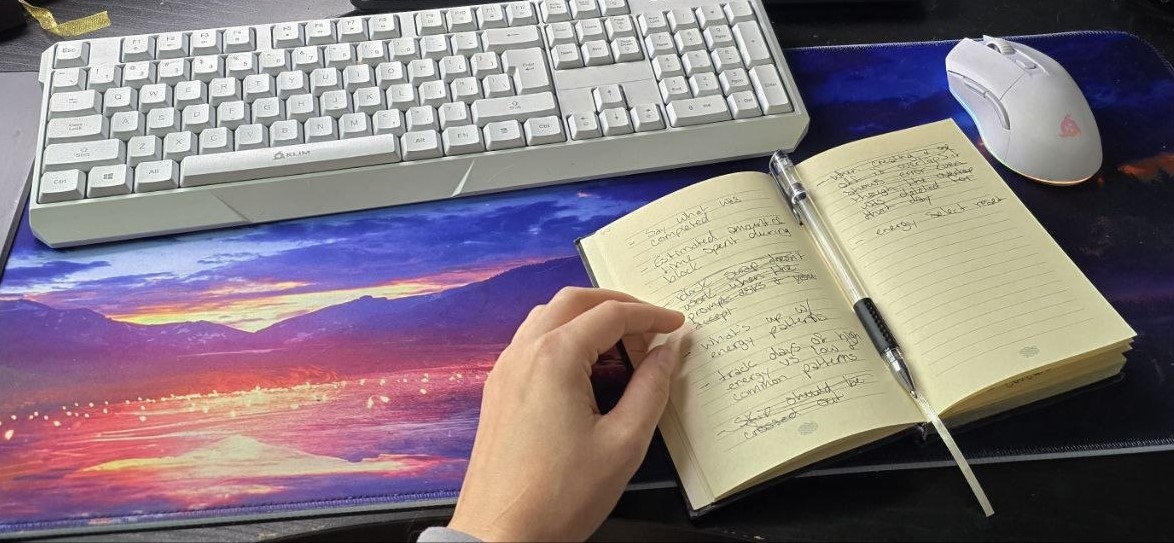
The list in that photo is from my own notebook — features for an app I'm building, sorted and crossed off as they moved from idea to real. The method works because it's the same method regardless of what's on the list.
You'll often find that the pile is smaller than it felt inside your head, and that more of it belongs in Tier One than you expected. That's not a disappointment. That's a map.
Use the interactive worksheet here or below to work through your own inventory — or print it and do it by hand.
Coming Back
The slump ends. It always does. But fighting it — pushing through on fumes, catastrophizing the silence, measuring yourself against an imaginary standard — extends it every time.
The gardener doesn't dig up seeds to check if they're growing. She reads the season, tends what she can, and trusts the rest to the soil.
Your slow season is not evidence of failure. It's evidence that you are responding honestly to your environment. That is not something to fix. It's something to learn to read.
Match your tasks to your actual capacity. Protect your silence from the noise that wears rest as a costume. And when the fog clears — and it will — you'll find you've been growing the whole time.
🌱 Over to You: Where are you in the tiers right now? Autopilot, semi-active, or waiting for full focus to return? Drop it in the comments — no context needed, just where you're at. You're not alone in the season.
Cognitive Load Tier Worksheet
Dump every task in your head, then sort each one into the tier that matches its real cognitive cost — not its priority.
Your list stays on your device. Nothing is sent to our servers — it's kept only in your browser's local storage, and clearing your browser data will clear it. Heads up: anyone who uses this browser on this device can see it.
Unassigned (0)
No unassigned tasks. Add one above to start sorting.
Tier 1 — Autopilot (0)
Muscle-memory tasks. Cleaning, laundry, errands, familiar routines. Your body, not your full mind.
Nothing here yet.
Tier 2 — Semi-Active (0)
Some thought, not deep focus. Organizing, light research, non-urgent messages, rough sketches.
Nothing here yet.
Tier 3 — Full Focus (0)
Writing, coding, deep creative work, complex problem solving. Protect this tier until capacity returns.
Nothing here yet.
Comments
No comments yet. Be the first to share your thoughts!